
Footbeds - a tale of two halves!. This article is about the heel end of the foot, the forefoot is another story.
Many walkers suffer from discomfort or blisters under the heel as we did in the early days, and try stuffing in heel cushions or some kind of padding to solve the problem. This is not the answer!. Your heel has a pad of its own and the crucial piece of information is simply this: your natural heel pad is far and away the best heel cushion in existence -
the trick is to ensure that it remains in the correct cupped shape - and that means effective footbeds.
Almost all the boot manufacturer supplied footbeds that we have seen are useless. They have a cupped heel shape but they are soft and squishy so what's the point?. As soon as you stand on them they squash flat, and so does your natural heel pad which then loses its effectiveness.
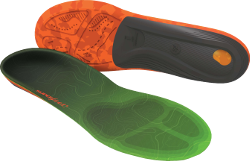
Good outdoor stores stock Superfeet footbeds.
These are full length off-the-peg footbeds with a firm heel cup and come in several varieties to suit the arch of your foot, available in Men and Women shaping and covered with a soft material that is very comfortable. We are currently using Superfeet Trailblazers and find them excellent. Some stores have staff who are specifically trained to guide customers in the fitting and selection of high or low arch style.
| Superfeet Footbeds website → |  |
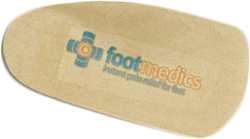
Another source of good off-the-peg footbeds to suit various gait requirements is a specialist footcare store. I used Gaitway footbeds (badged as Foot Medics) for a while from Shuropody who have local branches throughout the UK with resident podiatrists and whose staff seemed highly knowledgable.
They all have very effective heel cups that hold your heel in the central position by inward forces, giving increased stability on rough terrain.
The podiatrists can help you decide which style best approximates your feet and they will keep your heel in the all important cupped shape, a huge improvement on the useless things supplied with the boots.
| Shuropody website → |  |

This might be worth the investment for particularly troublesome gait/foot problems when off-the-peg orthotics are not sufficient.
Years ago I tore a ligament in my ankle and attended physiotherapy sessions, and in the course of it I had chance to chat to the resident podiatrist. We discussed walking at some length, including heel and other problems, and he remarked that I was probably overpronating. He looked at my Superfeet footbeds and agreed that they were much better than a standard footbed, but when I told him how much walking I did, he made a suggestion: a pair of custom made orthotics (picture at right).
These would match my feet perfectly in both heel and arch and correct my pronation at the same time, which he said was more important than I realised for the future health of my joints given that amount of walking, especially with a backpack. The only drawback was the cost - £227 for the consultation, prescription and manufacture, which I thought was ferociously expensive at first, but actually it compares well with the cost of a new pair of spectacles which is a very similar process. After a lot of agonizing thought I agreed, and at the time they were worth every penny.
The orthotics are made of rigid fibreglass (I believe) and overlaid with a thin layer of soft material that feels like vinyl. Being rigid, they are half length only. You might think that the front edge could be felt underfoot as a ridge but it can't, I am totally unaware of their presence. The wedge under the heel cup is precisely angled to correct my pronation.
I could then walk any distance over any terrain with any weight without the slightest hint of a problem or discomfort in the rear half of the foot, and I gain from the increased stability and corrected pronation.
Eventually after thousands of miles they did wear down and I successfully switched to the off-the-peg Superfeet Trailblazers.