
| OS Route Map → |  |
GPX Route file → |
Date: 19 May 2024
Start: / Finish: Church Stretton.
Maps: Explorer 217: The Long Mynd & Wenlock Edge.
| Day 1 | Caer Caradoc & Long Mynd | 9.4miles / 2178 feet (15.1km / 664m) |
| Day 2 | Minton Hill & Ragleth Hill | 6.6miles / 995 feet (10.6km / 303m) |
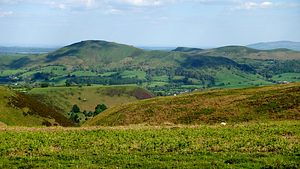
A 2-day solo circuit of the Shropshire hills around Church Stretton.
The outward line traverses the hill fort of Caer Caradoc and crosses the valley to ascend to to the heath/moorland plateau of The Long Mynd.
The return descends the ridge of Minton Hill and Packetstone Hill to Little Stretton to recross the valley for a traverse of Ragleth Hill.
The first day was unbroken sunshine with fantastic views, the second was misty and murky with dull local views but still enjoyable walking with plenty of interest.
The last time we walked these Shropshire hills was in 1997 which predates this site by six years, this was an opportunity to document a new trip area and resurrect some lost memories. I recall that the steeply incised valleys running south-eastwards from the Long Mynd plateau, and Carding Mill valley in particular, were extremely popular back then: on this trip on a sunny Sunday, even the small little known Gogbatch valley at the north-eastern end was busy with parked cars, family picnics and much paddling, though no hikers. Our walk log shows that we did the full length of Townbrook valley only: on return I researched the other valleys and they look splendid, if rather overmanaged for tourists in places, and possibly material for another backpack if I can imagine a suitable route at quiet times.
An already short day due to Sunday timetables was reduced by a further hour when my train was cancelled, but my route plan was open ended for the evening and could be decided later.
Walking the footpath approaching Caer Caradoc, I soon met a large contingent of walkers in a group returning from their ascent and a few more scattered along the way - I wasn't expecting these hills to be quiet on a sunny Sunday. The path crosses a footbridge and divides: one follows a direct slanting line to the highest and farthest top, I took the other that turns left for a complete traverse starting with a steep climb up to Three Fingers Rock. With the hard work done, the walking becomes very easy and the views are fine indeed.
Approaching the highest point, the slanting path joins to reach the hill fort and its preserved ramparts. Nearby to the north is The Lawley and in the distance The Wrekin, to the west is the enormous sprawl of The Long Mynd.
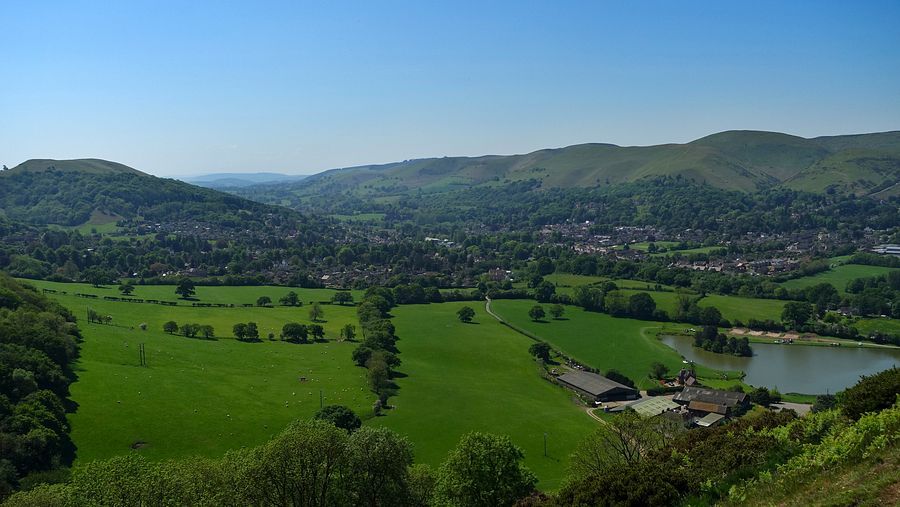
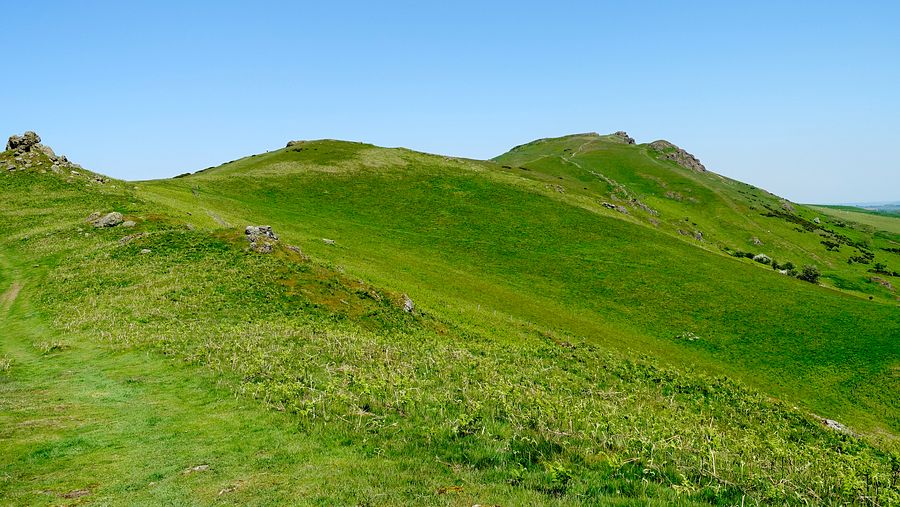
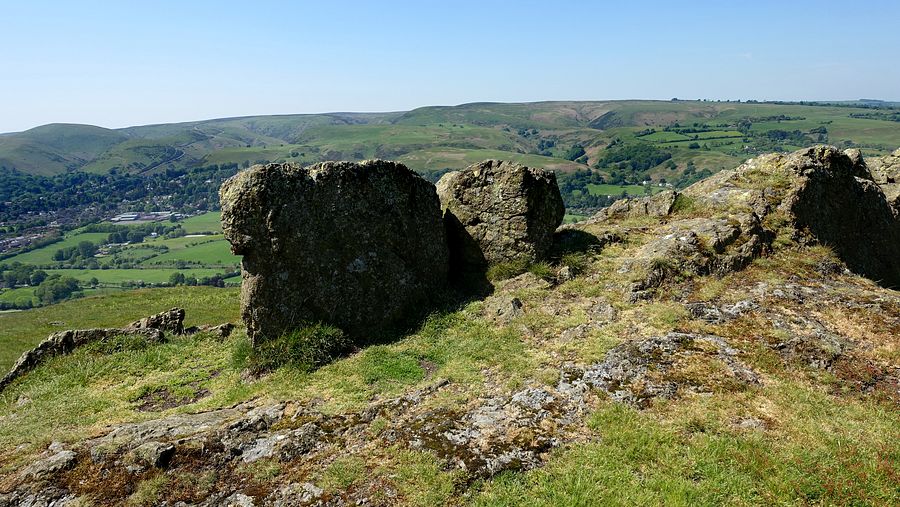
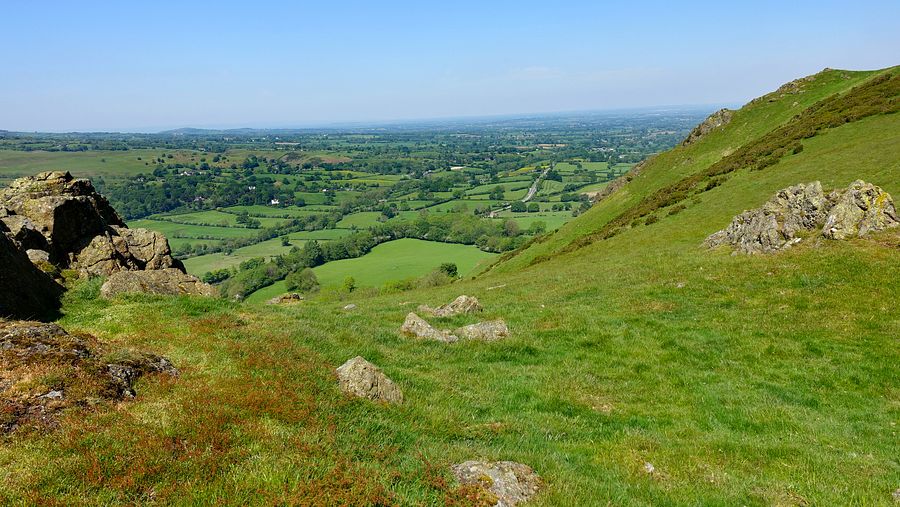
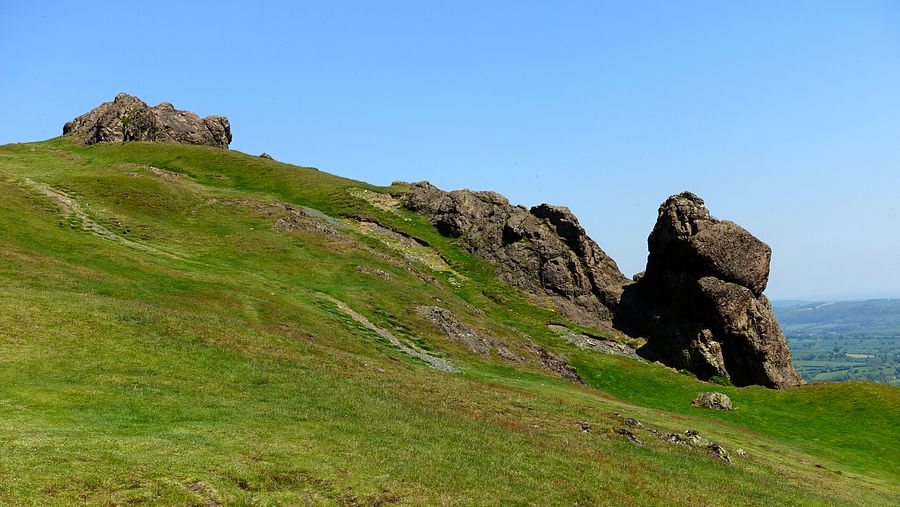
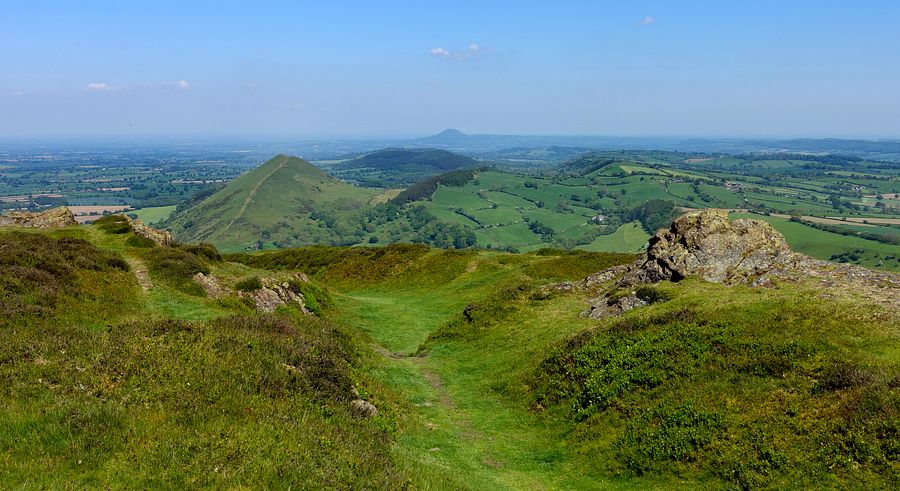
Descending north-eastwards I reached the foot of Little Caradoc and turned onto the footpath north-westwards descending to the lane at Botvyle Farm. A short way up the road is the footpath line directly across the valley to the lane at Highfield at the foot of The Long Mynd. Being a little walked line, I thought this valley crossing might present path problems but all the waymarks and furniture are in place, except for one slight omission: at SO 47080 96691 the map shows the footpath cutting off the road corner but there is no way through, just walk a few metres up the road around the corner and pick up the path on the adjacent road as shown on my map.
The path westwards from Highfield into the Gogbatch side valley is a lovely walk through a strip of woodland. My first plan was to cross the stream at SO 46420 96884 via the mapped footpath, but this is not at all feasible now - it looks like a right-of-way from the distant past that may once have been viable. No problem, I continued into the valley on the good path, past numerous families enjoying the hot sunshine, and stepped across the stream to enter another side valley ascending south-westwards - a nice easy walk and deserted too.
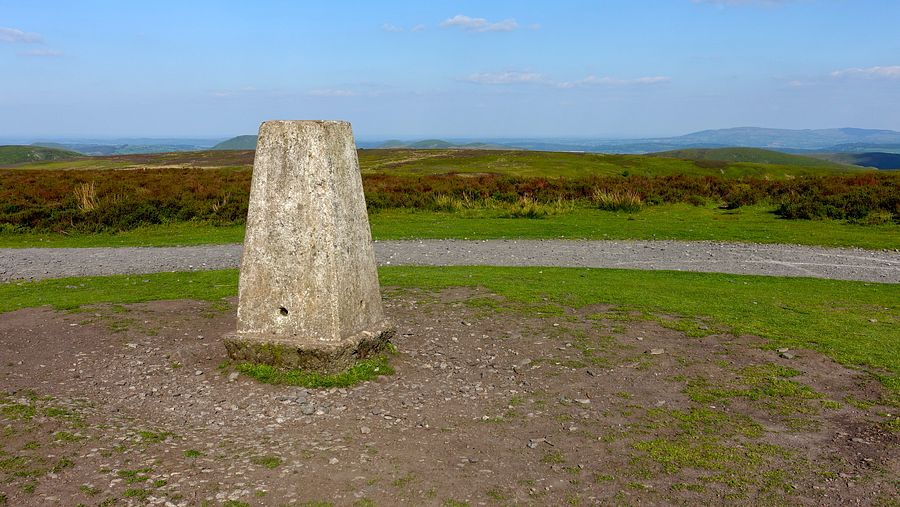
Higher up a forlorn waymark post lies on the ground showing a good path climbing more steeply left up the valley flank and joining the spider web of excellent paths on the plateau. The Long Mynd is very long indeed and criss-crossed by tracks and almost lawn-like wide paths. The map shows my line to the summit trig that gave great views across to Caer Caradoc. I noticed on the final approach a sign: "Bus Stops Here". There can't be many hills of 500m+ where you can catch a bus almost to the top but it's true in summer: the Shuttle Bus.
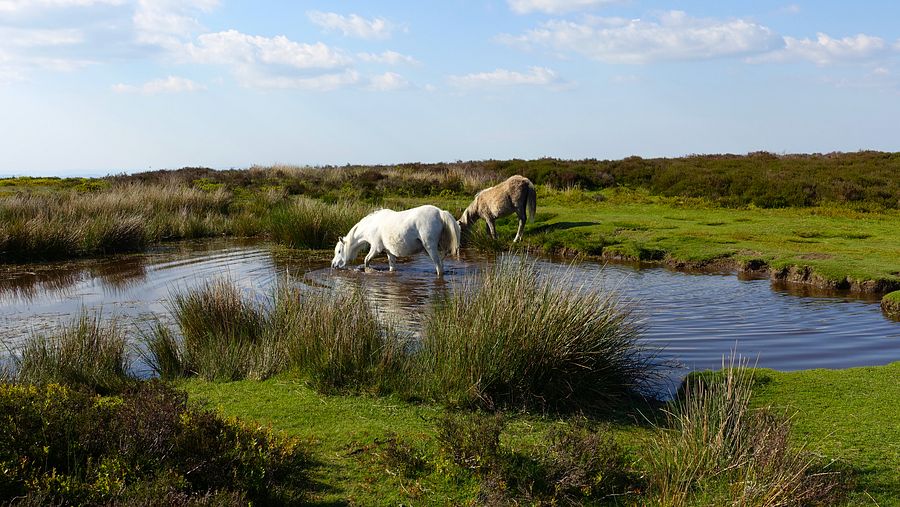
En route is a marked Restoration Area surrounding a plateau pool where two of the many free roaming horses obligingly walked over to drink. At the summit trig and topograph one family had brought up deck chairs and settled down.
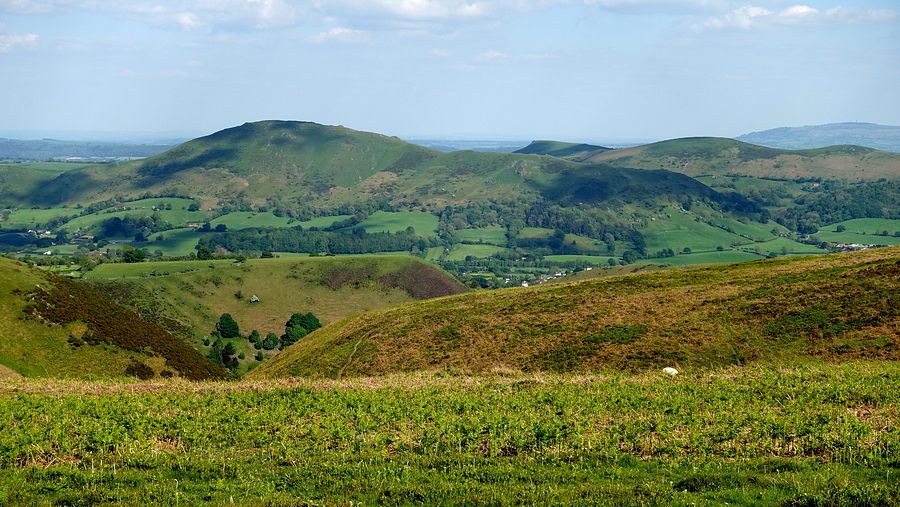
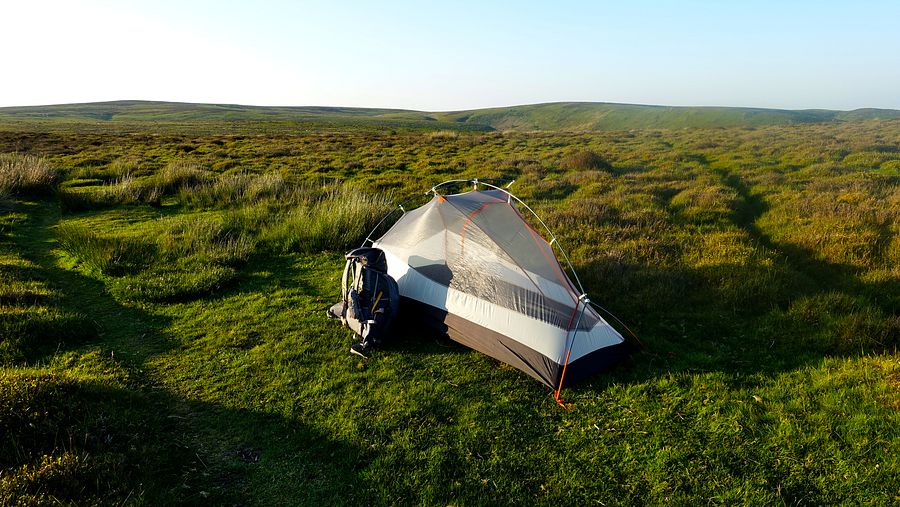
It was getting quite late and I adopted my shortest plan variation to head out for the environs of Round Hill. This yielded a very good pitch using just the inner tent in the warm air, relaxing in a light breeze under the clear sky and light of the moon. Later it turned out not such a good idea: in the early hours it became pretty chilly despite most of the breeze being stopped by the tent mesh: the flysheet would have made all the difference but I couldn't be arsed to fit it at this late stage in the dark. I put on my Microlite down top to compensate, I always carry this even in summer for just such occasions and it's very light and compact.
The abundant bird life of the Long Mynd was determined to rise early even if I wasn't, as I discovered when I got out for the inevitable pee in the first discernible glimmer of light in the east. Multiple skylarks were first, twittering away at around 03:30 and soon followed by the unmistakable dive-bombing sound of the snipe. Later a couple of Canada geese flew by honking and I heard what I was sure was the distant trill of a curlew.
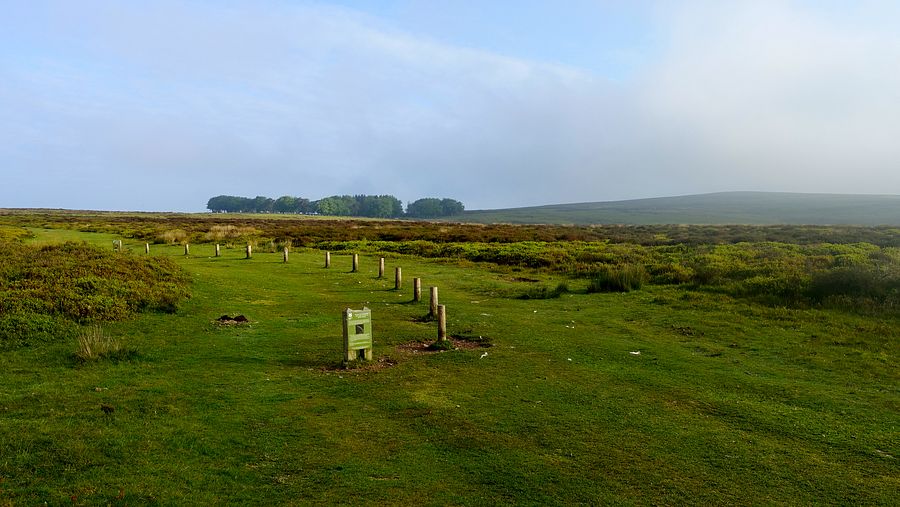
The sky was clear until dawn but then the mist rose to briefly engulf the Long Mynd summit and greatly dull the landscape and views. I set off retracing my steps to the summit road, passing a marked Bronze Age funerary barrow, and walked south to the turnoff for Minton Hill. Here there is a National Trust sign saying that only two pairs of curlew remain on the Long Mynd: it was them that I heard. A short while later one pair flew up together, trilling as if in confirmation.
The Minton Hill path is fine easy walking high on the flank, if only the views were as clear as yesterday but the pattern for today was established.
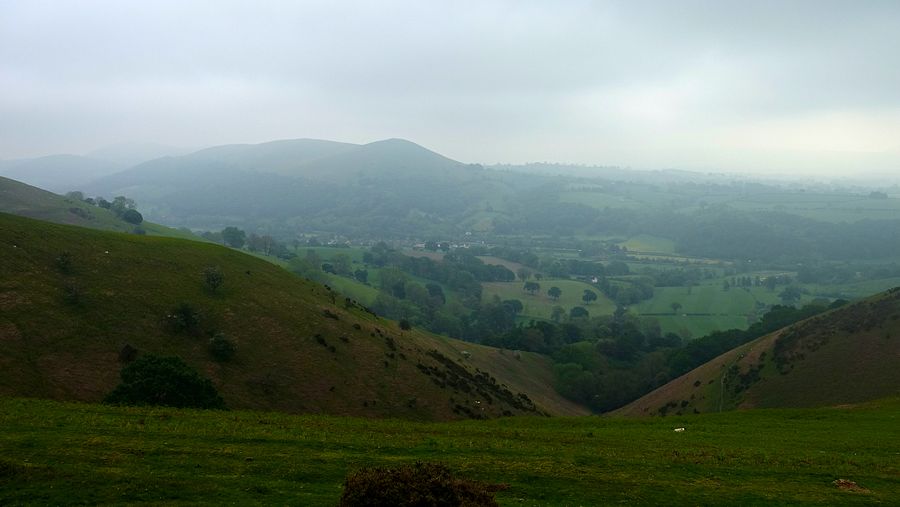
The path drops to Minton where I followed a narrow lane to Little Stretton with views across to the final objective Ragleth Hill and the formidable profile of its southern end.
On the far side of the A49 a footpath gives a gradual warmup ascent to the foot of the steep south face: off with the fleece, this was going to be warm, hard and slow, every bit as steep as it looked. I finally reached the top marked by a tall wooden post, put the fleece back on in the chilly breeze and settled down for a bite to eat, satisfying despite the dull views.
A short while later a young girl arrived at the top with a huge backpack, attached roll mat and other bits and pieces, the typical M.O of DOE groups. It had taken me seemingly ages to climb up with my very lightweight pack and gear but she had lugged that monster up here in no time. Oh for the power of youth!. Several more soon arrived with similar gear rigs. Jolly good show, you have to start somewhere and these girls were out here and learning in the best possible way.
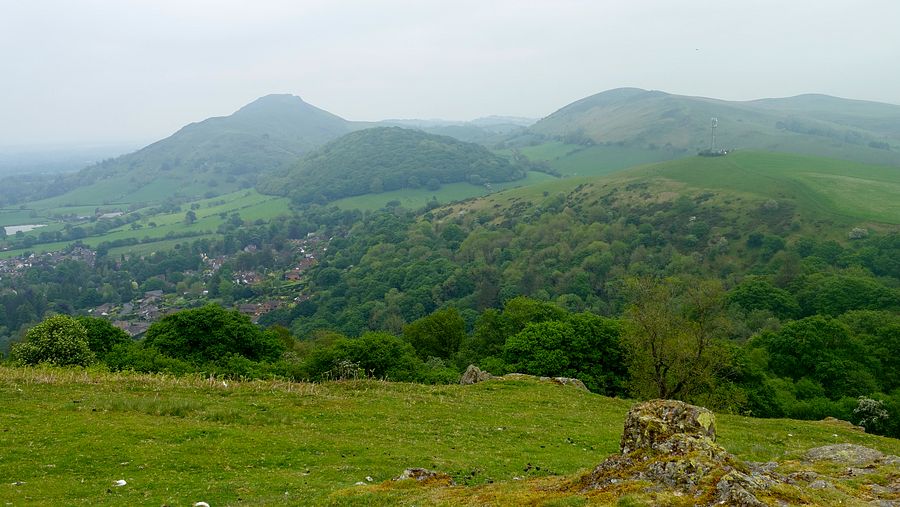
I had thought of continuing to cross Hope Bowdler Hill but it didn't seem worthwhile in these conditions. I traversed the northern top of Ragleth Hill and descended directly to Church Stretton for a short day.